
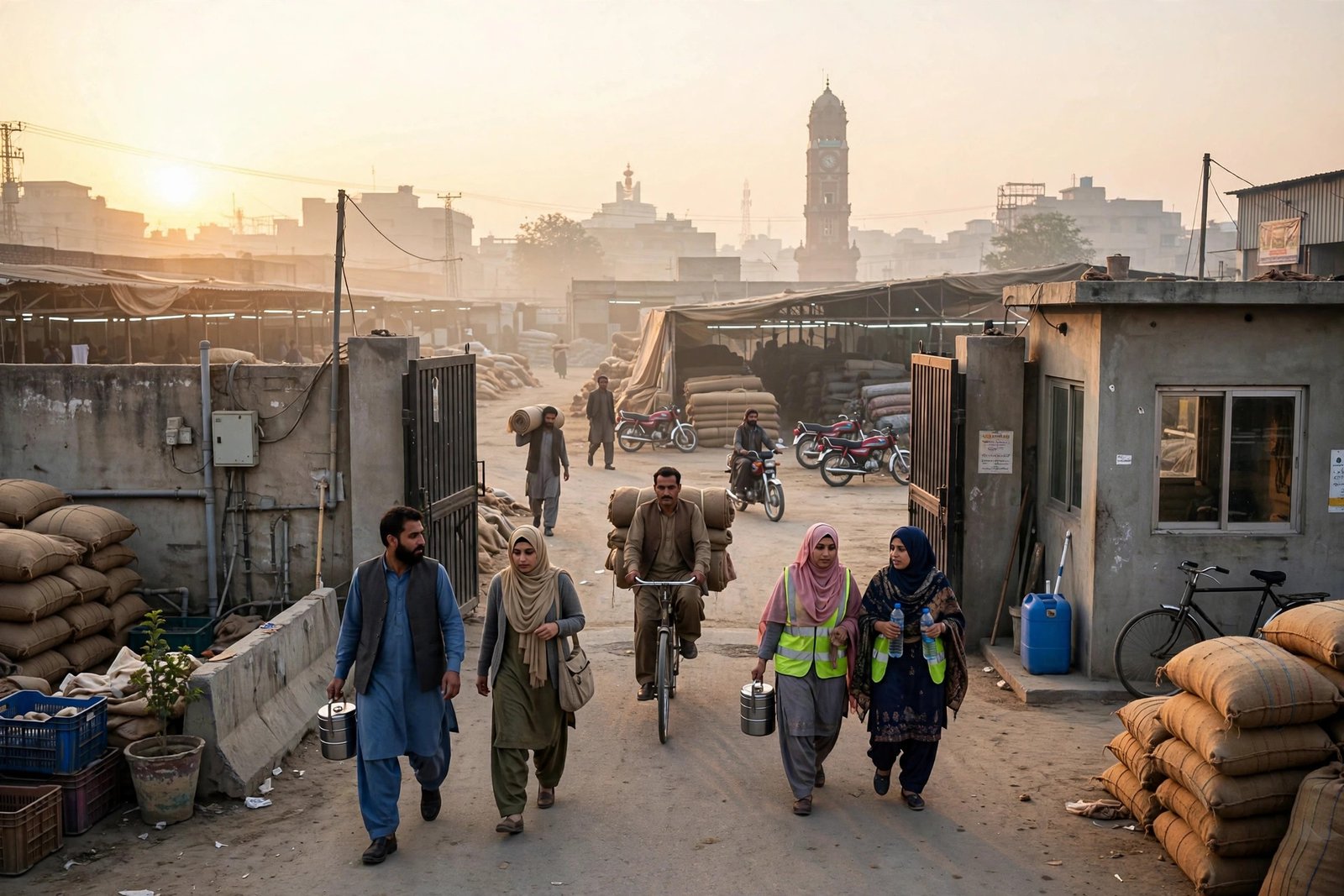
Ask most Pakistanis about jobs in Faisalabad and they will picture one thing: textile mills. And they are not wrong — this city spins, weaves, dyes and stitches a huge share of the country’s cloth, and the textile value chain employs hundreds of thousands of people here. But if you think Faisalabad is only textiles, you are missing half the job market. In 2026, the city also runs on banks, hospitals, universities, a growing IT scene, FMCG distribution, real estate and a food industry that feeds half of Punjab.
Faisalabad sits at the centre of Punjab’s commercial geography — close enough to Lahore for business, far enough to have its own economy and its own (lower) cost of living. This guide is the honest version: which industries actually hire here, where the real vacancies get posted, what salaries look like in 2026, how to get hired if you are coming from outside the city, and the scams to watch out for. Whether you are a fresh graduate from GCUF or NTU, a textile professional, or someone considering a move from Lahore, this is your starting map.
Table of Contents
Why Jobs in Faisalabad Deserve a Serious Look in 2026
Three things make Faisalabad’s job market worth your attention right now.
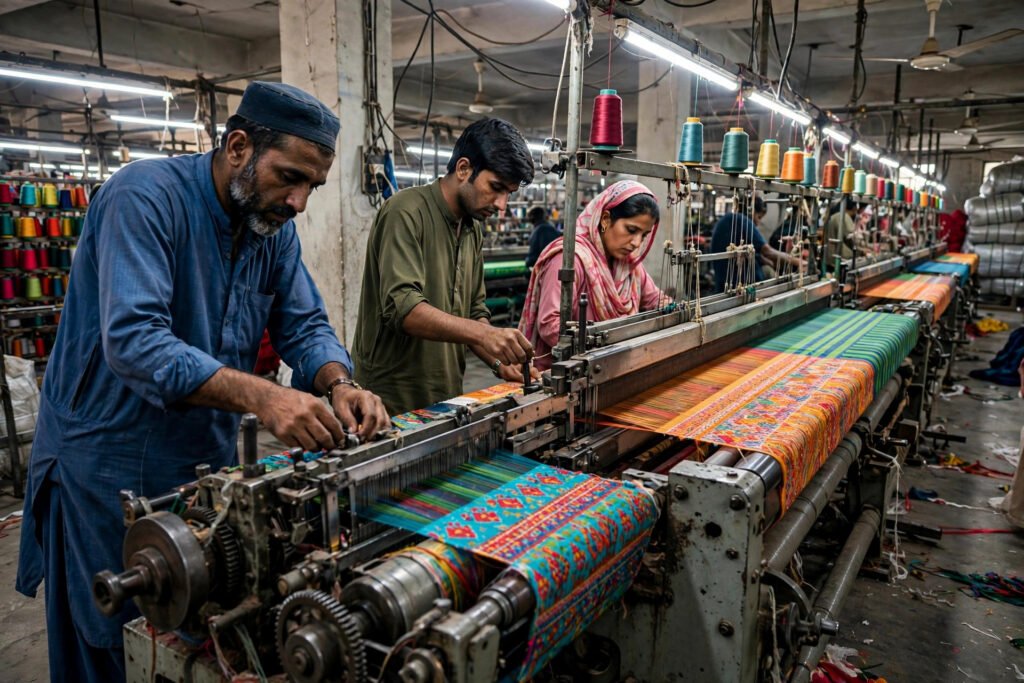
First, the textile engine is running hot again. After a rough few years of energy costs and export pressure, Pakistan’s textile exporters have stabilised, and Faisalabad — the “Manchester of Pakistan” — is where the orders land. Spinning mills, weaving units, processing houses, dyeing plants and garment factories from the M-3 Industrial City to the older units on Sargodha Road and Jaranwala Road are hiring: not just machine operators, but merchandisers, compliance officers, quality controllers, textile engineers, and export documentation staff. Value-addition (garments and home textiles rather than raw yarn) is where the margins — and the better-paying jobs — are.
Second, Faisalabad is Punjab’s commercial middleweight, and middleweights hire steadily. It is the distribution hub for central Punjab: FMCG companies, pharma distributors, auto and tractor dealers, and agri-input companies run regional offices here. Banks have deep branch networks. The education sector is enormous — the University of Agriculture Faisalabad alone is a small city, and private universities and colleges keep multiplying along Canal Road and Satiana Road. These sectors do not make headlines, but they hire every single month.
Third, the Lahore comparison works in your favour. Faisalabad is roughly two hours from Lahore, connected by motorway, which means companies increasingly treat it as part of the extended Lahore commercial zone — without Lahore’s rents. A professional earning 90,000 PKR in Faisalabad lives better than one earning 110,000 in Lahore. And if your career ever needs the Lahore market, our guide to jobs in Lahore maps that side of the corridor — many Faisalabad professionals work both markets across their careers.
Industries That Actually Hire in Faisalabad
Here is the real breakdown, beyond the “textiles” shorthand:
- Textiles and garments — the giant. Spinning, weaving, processing, dyeing, knitwear, home textiles, denim. Roles: textile engineers, merchandisers, QA/QC officers, compliance and sustainability officers (increasingly important for European buyers), production managers, export marketing staff, and skilled operators. NTU (National Textile University) graduates are the preferred pipeline, but mills also hire commerce and management graduates for commercial roles.
- Agri and food processing — UAF’s presence makes Faisalabad an agri-science hub. Seed companies, fertiliser and pesticide firms, dairy processors, flour mills, and rice and grain traders hire agronomists, sales officers, quality staff and supply-chain people. The city’s mandis and grain markets employ thousands in trading and logistics.
- Banking and microfinance — deep branch networks across the city and surrounding districts (Jaranwala, Samundri, Tandlianwala, Dijkot). Relationship managers, branch operations, SME lending officers and microfinance credit staff are steady hires. SME lending is a particular growth area as small textile units expand.
- Healthcare — Allied Hospital, DHQ Hospital, Punjab Medical College’s network, plus private hospitals (Aziz Fatima, Independent, SAHARA). Doctors, nurses, paramedics, lab technologists, pharmacists, hospital administrators and medical billing staff. The private hospital sector keeps adding beds, and staffing follows.
- Education — GCUF, NTU, UAF, Riphah, The University of Faisalabad, plus dozens of private colleges and school chains. Lecturers, teachers, admin and admissions staff. Hiring peaks around admissions season (August–September) and again mid-year.
- IT and freelancing — smaller than Lahore’s scene but real and growing. Software houses on Canal Road and in DHA Faisalabad do web development and outsourcing; a large freelance community works from home for foreign clients. The combination of low living costs and dollar income makes Faisalabad quietly attractive for remote tech workers.
- Real estate and construction — DHA Faisalabad, FDA City, Wadi-e-Sitara and Canal Road developments keep builders, dealers, architects and site engineers employed. Cyclical, but 2026 activity is healthy.
- Retail, food and hospitality — D Ground, Kohinoor City, Boulevard Mall and the restaurant strips on Canal Road and Satiana Road employ thousands in retail management, sales, food service and hospitality. Not glamorous, but immediate and abundant for young job seekers.
Where to Find Jobs in Faisalabad in 2026
Faisalabad’s hiring happens across formal portals and old-school networks. Use both.
- Rozee.pk — the broadest single source for Faisalabad postings: banks, FMCG, hospitals, textile commercial roles and IT. Set a city filter plus keyword alerts for your field.
- LinkedIn — essential for textile merchandising, export, banking and IT roles. Many Faisalabad mills and software houses post openings here that never reach the portals.
- University placement cells — NTU, UAF and GCUF run the strongest placement operations in the city. Their industry linkages place hundreds of graduates directly into mills and agri companies each year. If you studied at one, use the cell aggressively; if not, attend their job fairs anyway — several are open to outsiders.
- Newspaper classifieds — the Express and Nawa-i-Waqt Sunday editions still carry Faisalabad ads for schools, hospitals, banks and government-adjacent posts that skip the internet entirely.
- Industrial estate walk-ins — for production, QA and commercial roles in textile units, visiting the M-3 Industrial City or the units along Sargodha Road with a CV and confidence still works. The textile industry respects directness. Go on weekday mornings, ask for the HR or admin office.
- Trade body and chamber networks — the Faisalabad Chamber of Commerce & Industry circulates member-company openings; membership events are genuine networking opportunities, not just formalities.
What Faisalabad Salaries Look Like in 2026
Jobs in Faisalabad pay less than Lahore on paper and more than they look in practice, because the cost of living is genuinely low — decent family housing in Madina Town, Gulberg or along Canal Road costs a fraction of Lahore equivalents.
- Entry-level (fresh graduate, sales/admin/support): 35,000–55,000 PKR/month. Textile mills start management trainees around 45,000–60,000; banks similar; retail and food service lower but with quicker moves up.
- Textile mid-level (merchandiser, QA officer, production supervisor, 3–6 years): 70,000–150,000 PKR/month. Export merchandisers with European-buyer experience command the top of this range and above.
- IT/software: 80,000–200,000 PKR/month locally; remote-for-foreign-client developers earn in dollars, often 2–4x local salaries.
- Banking mid-level (branch manager, SME lending): 90,000–180,000 PKR/month plus bonuses.
- Doctors and lecturers: 80,000–250,000 PKR/month depending on institution and seniority; private practice on top for doctors.
Negotiation note for Faisalabad: employers here often open low, expecting you to negotiate — especially mills and trading houses. Always counter the first offer, and always ask about the full package: many textile employers provide transport, subsidised meals, medical coverage and annual bonuses that materially change the real number.
Getting Hired From Outside Faisalabad
Relocating professionals are common here — the mills actively recruit from across Punjab. A few practical points:
Signal commitment early. Out-of-city CVs get filtered because employers assume you will leave. State your relocation plan plainly: “Relocating to Faisalabad; available for in-person interviews from [month].” If you have family in the city or studied at UAF/NTU/GCUF, say so — it answers the staying-power question instantly.
Learn the city’s commercial geography before interviews. Knowing the difference between the M-3 Industrial City, the Sargodha Road units and the Canal Road commercial belt — and being able to talk about it — tells a textile or FMCG employer you have done your homework. Ten minutes on a map beats a generic cover letter.
Consider the Lahore–Faisalabad corridor as one market. Plenty of professionals live in Faisalabad and work with Lahore-based companies (or vice versa), especially in textiles, where the two cities’ industries are deeply linked. Do not artificially limit your search to one city’s listings.
For textile roles, certifications beat degrees alone. A commerce graduate with a merchandising or compliance short course (many are offered in Faisalabad itself) outranks a plain BBA in mill hiring. European-buyer compliance knowledge — sustainability, labour standards, certifications — is the highest-leverage skill in the sector right now.
Job Scams in Faisalabad: What to Watch For
- Fake mill “HR agents” charging placement fees — real textile mills hire through their own HR departments, campus placements or advertised posts. Anyone asking for money to “confirm your seat” in a mill is running a scam.
- Overseas employment fraud — Faisalabad sends many workers to the Gulf, and fake agents thrive on it. Verify every recruiter’s licence with the Bureau of Emigration and Overseas Employment before paying anything. Never pay for a visa to an individual.
- “Earn from home” data-entry and typing schemes — pay a registration fee, receive “work,” never receive payment. Real employers pay you; they never charge you to start.
- Commission-only sales jobs dressed as salaries — some dealerships and real-estate offices advertise a “salary” that turns out to be pure commission with impossible targets. Ask for the offer letter in writing before resigning your current job.
FAQs About Jobs in Faisalabad
Is Faisalabad only about textile jobs?
No — textiles are the biggest single employer, but banking, healthcare, education, FMCG distribution, IT, real estate and retail all hire steadily. If your skills are in sales, accounts, marketing, teaching, nursing or software, Faisalabad has a market for you that has nothing to do with looms.
Which jobs pay best in Faisalabad in 2026?
Export merchandising with foreign-buyer experience, software development (especially remote for foreign clients), senior banking roles, and specialist doctors. In textiles specifically, compliance and sustainability roles are the fastest-growing high-pay niche as European buyers tighten requirements.
I studied at NTU/UAF/GCUF — how do I use that?
Aggressively. These universities are Faisalabad employers’ preferred hiring pipelines. Use the placement cell, attend every industry linkage event, and keep in touch with seniors already in mills and agri companies — referrals from alumni carry real weight in this city’s hiring culture.
Can I live in Faisalabad and work remotely for a Lahore or foreign company?
Yes, and many people do. The motorway makes occasional Lahore trips easy, fibre internet is widely available, and the low cost of living means a Lahore or dollar salary goes very far here. This is one of the most financially efficient setups in Pakistan right now.
When is the best time to job-hunt in Faisalabad?
Textile hiring runs year-round but peaks when export orders surge (typically spring and autumn). Education hiring peaks August–September. Banks and FMCG hire on quarterly cycles — January, April, July and October are the months to watch.
Conclusion
Jobs in Faisalabad in 2026 reward people who look past the single-industry stereotype. Yes, textiles are the backbone — and for textile professionals, this city is arguably the best place in Pakistan to build a career. But the banks, hospitals, universities, distributors and software houses hire too, the cost of living lets your salary breathe, and the Lahore corridor keeps your options open in both directions.
Start this week: set your jobs in Faisalabad alerts on Rozee.pk, refresh your LinkedIn, check the Sunday classifieds, and if you are in textiles, walk into the M-3 Industrial City with your CV. The Manchester of Pakistan still rewards people who show up.
One Response