
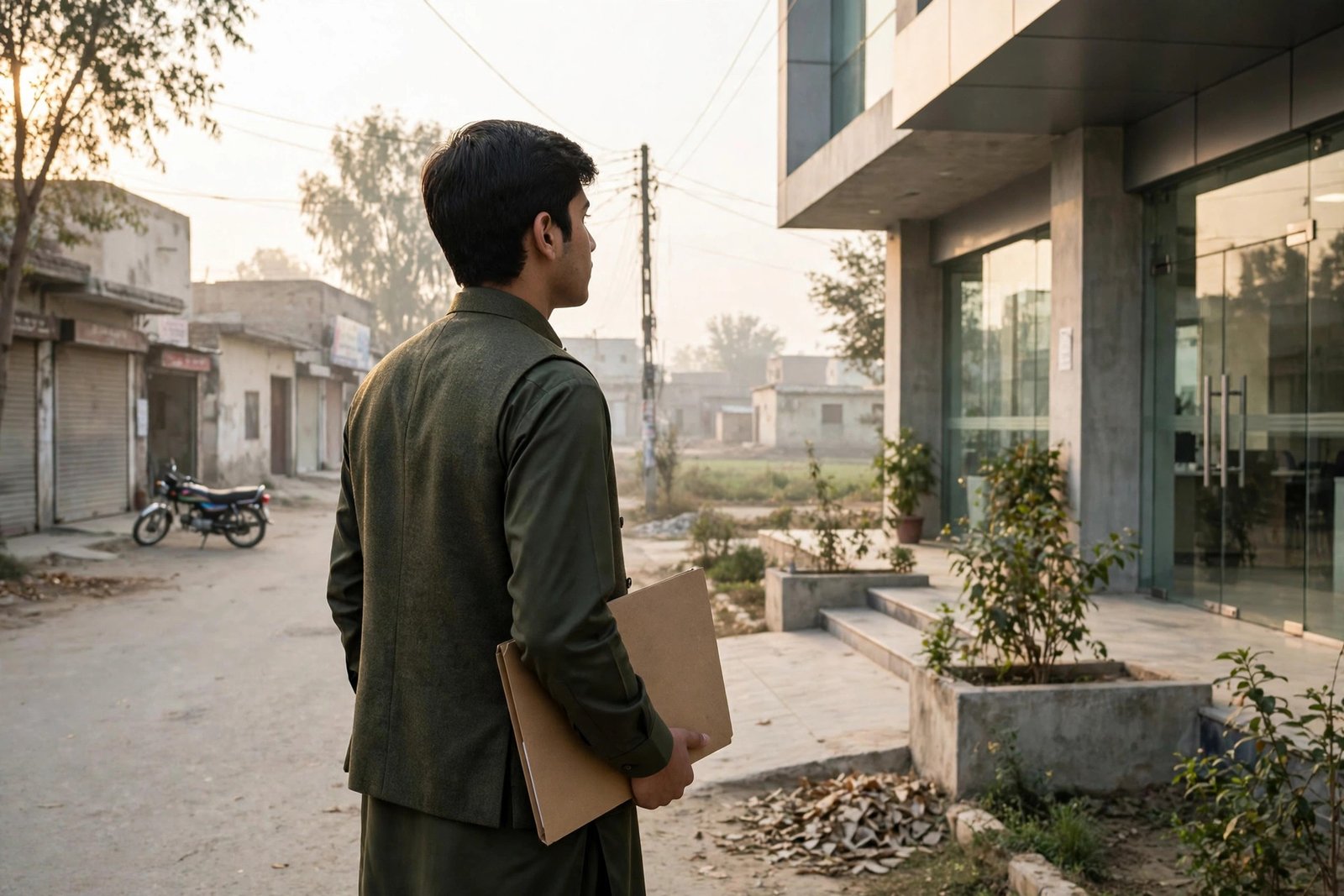
If you live in Chakwal, you already know the usual story: people either head to Rawalpindi or Islamabad for work, or they settle for whatever opens up locally. But that picture is changing. Chakwal’s own job market in 2026 is wider than most people realise. Between the cement plants, the growing education sector, health facilities, banks, retail, and the steady flow of government offices, there are real opportunities right here in the district — provided you know where to look and how to present yourself.
This guide is written for Chakwal residents, students finishing their degrees, and anyone thinking of moving back home after studying or working in a bigger city. It covers the main employment sectors, realistic salary expectations, and the practical steps that actually help you land a job — without the fake vacancy lists and exaggerated promises you see on too many job sites.
Why Chakwal’s Job Market Deserves a Closer Look
Chakwal is a district headquarters town with a population that keeps growing, and with it, demand for services. It sits close enough to Rawalpindi that commuting is possible, but far enough that local employers genuinely need local staff. That middle position is an advantage: you can apply for jobs in the city while also building a career at home, where living costs are lower and competition for many roles is far less intense than in Rawalpindi or Islamabad.
The other thing worth noting is that Chakwal’s economy is not dependent on a single industry. Cement, agriculture, education, health, retail, and government services all contribute. When one sector slows down, the others usually keep hiring. That mix gives job seekers more than one door to knock on.
Cement Industry: The District’s Biggest Private Employer
Chakwal’s cement industry is the backbone of its private-sector employment. Bestway Cement operates major plants in the district, and a network of related businesses — limestone quarrying, transport contractors, workshops, and suppliers — surrounds them. Together, these create jobs at every level.
The roles here go well beyond plant operators. Cement plants need mechanical and electrical engineers, mining engineers, chemists for quality control, safety officers, store keepers, accounts staff, HR officers, drivers, and security personnel. Contractors linked to the plants hire welders, fitters, electricians, heavy-vehicle drivers, and helpers. If you hold a DAE, a BSc in engineering, or even a relevant trade certificate, this sector is worth a serious look.
How to approach it: keep an eye on the career pages of the major cement companies and on reputable job portals, but also understand that a lot of hiring here happens through referrals and walk-in applications at plant offices. A neatly prepared CV dropped off in person, with copies of your certificates, still carries weight in Chakwal. For trade roles, your practical skill matters more than your CV format — be ready to demonstrate it.
Typical salary ranges in this sector vary widely by role. Helpers and junior trade staff commonly start around PKR 35,000 to 50,000 per month, skilled technicians and drivers often fall in the PKR 50,000 to 90,000 range, and engineers or supervisory staff can earn PKR 100,000 to 200,000 or more depending on experience. These are typical market ranges, not guarantees, and shift allowances or overtime can change the picture.
Education Sector: University of Chakwal, Colleges, and Schools
The University of Chakwal has changed the district’s employment landscape. A university brings teaching jobs, but it also brings administrative roles, library staff, lab technicians, IT support, accounts officers, and campus services. As the university grows, so does this demand.
Beyond the university, Chakwal has a solid network of government and private colleges and schools. Private schools and academies in particular hire regularly — for subject teachers, Montessori teachers, coordinators, and admin staff. English, mathematics, science, and computer science teachers are usually in the highest demand.
If you are a fresh graduate, teaching is one of the most accessible entry points in Chakwal. A BSc or BA with a B.Ed strengthens your application, but many private schools will hire strong graduates and train them on the job. Salaries in private schools commonly range from PKR 30,000 to 60,000 per month for teachers, with senior or specialist teachers earning more. University and college lecturers typically earn significantly more, depending on qualifications and whether the post is permanent or visiting.
Practical tip: visit schools and colleges in person with your CV during admission season and before the new academic session. Many private institutions hire quietly, without ever posting an online advertisement.
Health Sector: DHQ, THQ, and Private Clinics
Health is another steady employer in Chakwal. The District Headquarters (DHQ) Hospital in Chakwal city and the Tehsil Headquarters (THQ) hospitals in Talagang, Choa Saidan Shah, and Kallar Kahar employ doctors, nurses, dispensers, lady health visitors, lab technicians, pharmacists, and support staff. Government health jobs are usually advertised through the Punjab health department or district recruitment, so watch official notices rather than relying on social media forwards.
Private clinics, laboratories, and pharmacies add another layer of jobs. A D-Pharmacy graduate, a lab technician with an MLT diploma, or a nurse with recognised training can find work in private facilities relatively quickly. Salaries for private-sector health support roles commonly start around PKR 35,000 to 60,000 per month, rising with experience and specialisation. Government pay scales follow official grades, which are publicly available and worth checking before you apply.
Banks, Retail, and Services
Every bank branch in Chakwal — and there are many, from nationalised banks to private and Islamic banks — needs cashiers, relationship officers, operations staff, and branch managers. Banking jobs are popular because they offer structured career growth, but they are also competitive. A commerce or business degree, decent English and Urdu communication skills, and basic computer literacy are the usual requirements for entry-level roles. Bank trainee and cash officer roles commonly start around PKR 45,000 to 70,000 per month.

Retail is growing too. Chakwal’s main bazaars, shopping plazas, and new retail outlets need sales staff, cashiers, store managers, and delivery riders. Mobile phone shops, electronics stores, and grocery outlets hire frequently. These jobs often do not require a degree — reliability, honest dealing, and customer handling matter most — and typical pay ranges from PKR 30,000 to 55,000 per month, sometimes with commission on top.
For those interested in the wider region, it is also worth comparing opportunities in nearby cities. Our guide to jobs in Rawalpindi covers a much larger market just a short journey away, and many Chakwal residents successfully combine a Rawalpindi job search with local applications: https://talentnetwork.courseonic.com/jobs-in-rawalpindi-2026/
Agriculture, Transport, and Small Business
Chakwal remains an agricultural district. Groundnut, wheat, and pulses farming, along with livestock, support a whole economy of jobs: input suppliers, tractor and machinery workshops, feed mills, dairy collection points, and mandi work. If you have agricultural knowledge or a related diploma, agri-input companies and veterinary services are worth exploring.
Transport is equally important. Chakwal’s position on routes linking Rawalpindi, Jhelum, and the motorway network means transport companies, bus services, and goods carriers employ drivers, conductors, booking clerks, and mechanics. Driving jobs, especially for HTV and LTV licence holders, are consistently available, with typical monthly earnings from PKR 40,000 to 80,000 depending on the vehicle and route.
Small business is the often-overlooked path. Many Chakwal residents build a living through a small shop, a workshop, a tuition academy, or a services business. If formal employment is slow, a small, well-run venture — a mobile repair shop, a ladies’ tailoring unit, a photocopy and printing point near a college — can earn as much as a junior office job and grows with your effort.
Government Offices and Public Sector Roles
As a district headquarters, Chakwal hosts the full range of government offices: the district administration, police, education and health departments, revenue offices, municipal services, and courts. Government jobs here are filled through provincial recruitment bodies, departmental advertisements, and the Punjab Public Service Commission for higher posts. Keep an eye on official advertisements in newspapers and on government portals, and be wary of anyone claiming to arrange a government job for a fee — that is almost always a scam.
Clerical roles, patwaris, junior clerks, naib qasids, drivers, and computer operators are the most common district-level openings. Competition is real, but local candidates with complete documents and domicile of the district are well placed.
How to Apply: CV and Interview Tips That Actually Work
A good CV for Chakwal’s job market does not need to be fancy — it needs to be clear and honest. Keep it to two pages. Put your contact number and CNIC district at the top, list your education with years, then your experience with actual duties, not just job titles. If you have a skill — driving licence category, computer course, trade certificate — state it plainly. Employers here value straightforward CVs over decorated ones.
When you apply online, use reputable job portals rather than random WhatsApp forwards. You can browse verified listings on Rozee, one of Pakistan’s most established job platforms: https://www.rozee.pk
For interviews, the basics matter more than people think: arrive on time, dress neatly, bring original documents plus photocopies, and be ready to answer in Urdu or English — whichever the interviewer uses. Research the employer beforehand; even a basic understanding of what the company does sets you apart from most applicants. And always ask one sensible question at the end, such as what the working hours or training arrangements are. It shows genuine interest.
Follow up once, politely, a week after applying. Do not pester. If you do not hear back, move on to the next application — volume and persistence, not a single perfect application, is what gets results.
Realistic Salary Expectations in Chakwal
It helps to set expectations honestly. Salaries in Chakwal are generally lower than in Islamabad or Lahore for the same role, but so are rent, transport, and daily living costs. A fresh graduate should expect PKR 30,000 to 50,000 per month in most local private roles. With two to three years of experience, PKR 50,000 to 90,000 is a realistic range for skilled or supervisory work. Senior professionals — experienced engineers, doctors, bank managers, and senior teachers — can earn PKR 100,000 and above. Treat any advertisement promising far above these ranges for a junior role with suspicion until verified.
Job Scam Red Flags in Chakwal
Sadly, job scams target smaller cities heavily, because hopeful applicants are less likely to verify. Watch for these warning signs:
- Any demand for an upfront fee for “registration,” “training,” or “security deposit” before you start work. Genuine employers do not charge you to hire you.
- Job offers received only through WhatsApp, with no company website, office address, or verifiable phone number.
- Offers that promise an unusually high salary for a role requiring no qualification or experience.
- Requests for your bank details, CNIC copy, or original documents before any interview has taken place.
- “Work from home” schemes asking you to pay for a starter kit or to recruit others for commission.
If something feels off, verify the employer independently: search for the company name, call its listed office number, or ask at the local chamber or a trusted contact. Never pay to get a job.
Frequently Asked Questions
What are the best-paying jobs in Chakwal?
Engineering and supervisory roles in the cement industry, senior banking positions, doctors and specialists in health facilities, and university teaching posts tend to pay best. For most people, the realistic top of the local market sits above PKR 100,000 per month, but reaching it requires qualifications and experience.
Can I find a job in Chakwal without a degree?
Yes. Trade skills, driving licences, retail experience, and vocational certificates open real doors in cement plants, workshops, transport, health support roles, and retail. A short technical course often improves your prospects more than another year of general education.
Is it better to work in Chakwal or commute to Rawalpindi?
It depends on your field. Teaching, health, banking, and cement jobs are strong locally. IT, corporate, and specialised roles are far more plentiful in Rawalpindi and Islamabad. Many people start locally, build experience, and move to the city later — or keep a local job and avoid the daily commute entirely.
How do I find government jobs in Chakwal?
Follow official advertisements from the Punjab government, the health and education departments, and the Punjab Public Service Commission. Ignore social media posts claiming unpublished vacancies, and never pay anyone who promises to arrange a government posting.
What should a fresh graduate in Chakwal do first?
Prepare a clean two-page CV, register on reputable job portals, visit local schools, banks, and offices in person, and consider a short skill course — computer skills, English communication, or a trade certificate — while you apply. The combination of applications plus one concrete skill is what gets the first job.
Final Thoughts
Chakwal’s job market rewards the same things everywhere: relevant skills, a clear CV, persistence, and a healthy scepticism towards offers that sound too good to be true. Whether your path runs through the cement plants, a classroom, a hospital ward, a bank branch, or your own small business, there is work here in 2026 — and building your career at home, close to family and at a lower cost of living, is a choice more Chakwal residents are making with good reason. Start with the sectors that match your qualifications, apply widely, and keep learning one skill at a time.