
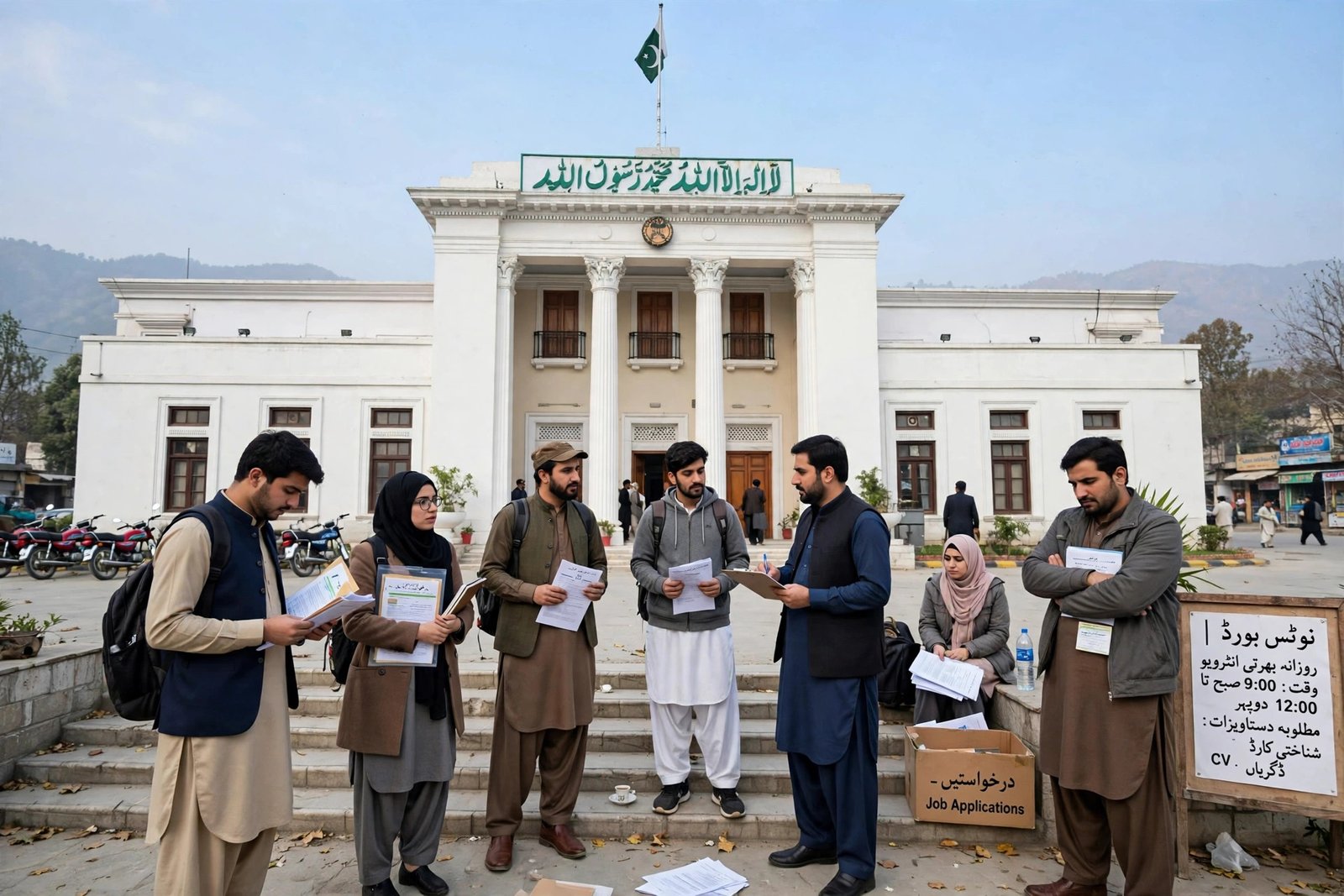
Haripur is one of those districts in Pakistan that quietly offers more jobs than most people realise. It sits in Khyber Pakhtunkhwa, right on the edge of Islamabad — close enough that many people commute to the capital for work, yet with its own government offices, colleges, industries and hospitals that hire locally every year.
If you live in Haripur, or you are thinking of moving there for work, you do not need to look far. Jobs in Haripur come from government departments, teaching institutions, the Hattar Industrial Estate, health services and the big projects around Tarbela Dam, and 2026 has already brought fresh openings in several of these sectors.
This guide covers the whole picture for 2026: where the jobs in Haripur actually are, which departments hire and through which testing services, what teaching and faculty jobs look like this year, how to apply through KPPSC and ETEA, what the private sector at Hattar offers, and how to avoid the fake job advertisements that target job seekers in smaller districts more than anywhere else.
Government Jobs in Haripur
Government jobs are still the first choice for most families in Haripur, and for good reason: regular pay, job security, a pension, and medical facilities. In Haripur, government hiring runs through the same provincial system as the rest of Khyber Pakhtunkhwa. The Khyber Pakhtunkhwa Public Service Commission (KPPSC) handles officer-level posts, while the Educational Testing and Evaluation Agency (ETEA) conducts screening and written tests for a large number of departmental posts, including many in education, health and district administration.
Domicile matters in all of this. Government posts in Khyber Pakhtunkhwa are open to KP domicile holders, and many posts are distributed by district or zonal quota. A Haripur domicile is an advantage for district-based posts, and it is also the document you will be asked for at the interview stage, so keep it ready along with your CNIC and educational certificates. If you are applying from outside the province, read the quota rules in the advertisement first — applying without the right domicile is the quickest way to have an application rejected at the document check.
District-level posts that appear most often are clerks, junior clerks, naib qasids, drivers, patwaris and police constables. The education requirement is usually Matric or Intermediate for the lower posts and a bachelor’s degree for the higher ones, and the age limit for most government jobs in Haripur is between 18 and 30 years, though the exact limit varies by post and by department. Always check the age limit in the advertisement itself rather than trusting what someone told you.
For a wider view of how provincial hiring works across the region, our guide to the neighbouring district is a useful companion read: Jobs in Abbottabad 2026, which explains the KPPSC and ETEA process and the district quota system in the same Hazara division.
Teaching Jobs in Haripur
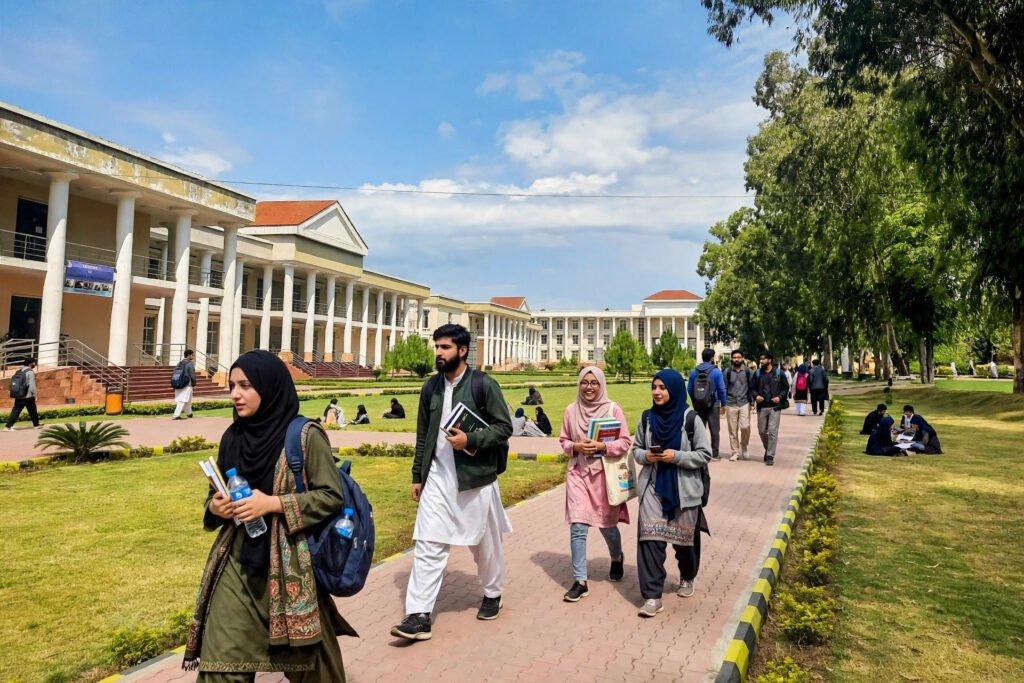
Teaching is one of the most reliable sources of jobs in Haripur, because the district has schools, colleges and universities that all hire on a regular cycle. Government school teaching posts are announced through the district education office and tested by ETEA, and the usual posts are Primary School Teacher, Certified Teacher and Subject Specialist, with requirements ranging from Matric with a teaching certificate for the lower posts to a master’s degree for subject specialists.
Private schools and colleges in Haripur city and Khalabat Township also advertise teaching posts throughout the year, usually in local newspapers and on notice boards, and they often hire faster than the government system, though the pay is typically lower and there is no pension.
Two institutions stand out for anyone looking for teaching jobs in Haripur. The first is the University of Haripur, a public-sector university in the district that employs lecturers, assistant professors and administrative staff, and announces its vacancies on its own website and in national newspapers. University posts are advertised through the university itself rather than through KPPSC, and the selection process usually involves a written test or demonstration followed by an interview. The second is Pakistan Public School & College in Khalabat Township, a well-known institution that advertises teaching and administrative vacancies on its careers page and in the press.
PAF-IAST: Faculty Jobs in 2026
The biggest single teaching opportunity in Haripur this year comes from the Pak-Austria Fachhochschule: Institute of Applied Sciences and Technology, better known as PAF-IAST. The institute sits at Mang on Khanpur Road in Haripur, and it has become one of the district’s most important employers for educated professionals. PAF-IAST announced faculty jobs in 2026, with applications invited for teaching positions across its departments, and the last date to apply was 22 November 2026.
Faculty posts at an institute like PAF-IAST typically ask for a master’s degree or a PhD in the relevant field, along with teaching or research experience, and the selection process involves shortlisting followed by an interview and sometimes a demonstration lecture.
The pay for faculty positions at a specialised institute is usually better than at an ordinary college, and the working environment — modern labs, international linkages and a purpose-built campus — is a genuine draw for academics. If you missed this round, keep watching the PAF-IAST website and the national newspapers, because an institute that is still growing tends to advertise again, and the next round often comes within a year.
Hattar Industrial Estate: Private Sector Jobs
For people who are not chasing a government post, the Hattar Industrial Estate is the largest single source of private jobs in Haripur. Hattar is one of Pakistan’s established industrial estates, located near Haripur city, and it hosts factories in pharmaceuticals, steel, food processing, textiles, packaging and chemicals, among others. Between them, these units employ thousands of workers — machine operators, technicians, quality-control staff, store keepers, drivers, security guards, accountants and managers.
Industrial jobs at Hattar are usually advertised through newspaper classifieds, through job portals, and very often through walk-in interviews announced at the factory gate or in local papers.
The education requirement varies widely: a factory labourer or helper may need only basic literacy, a machine operator usually needs a technical diploma or relevant experience, and a quality-control or accounts post typically needs a bachelor’s degree or a diploma in the relevant field. Pay in the private sector varies a great deal by post and by company, so treat any figure you hear from a friend as a rough guide rather than a promise, and confirm the actual salary at the interview.
The honest picture of industrial work is that it is steady but demanding: shift work, physical work, and production targets are part of the job. The upside is that experience at Hattar is portable — a technician who learns a trade in a pharmaceutical plant can move to another plant, or to Islamabad’s industrial areas, with that experience behind him. For a young person in Haripur without a degree, a technical skill learned at Hattar is often worth more than another year spent waiting for a government advertisement.
Health Jobs: DHQ Hospital Haripur
Health is another steady source of jobs in Haripur. The District Headquarters Hospital in Haripur is the district’s main public hospital, employing doctors, nurses, lady health visitors, medical technicians, dispensers, ward staff and administrative workers. Health department posts in Khyber Pakhtunkhwa are generally announced through the provincial health department and tested by ETEA, while the hospital itself sometimes advertises support staff directly.
Nursing and paramedical posts are recruited regularly, and private clinics in Haripur city and Khalabat Township also hire nurses, receptionists and technicians through local advertisements. For women in Haripur, health jobs are among the most accessible government careers, and the demand for qualified staff is consistent year after year.
Tarbela Dam, WAPDA and the Wider Area
Haripur’s job market is also shaped by what sits just outside the district. The Tarbela Dam, one of the largest earth-filled dams in the world, is on the Indus River near Ghazi in Haripur district, and the Water and Power Development Authority (WAPDA) remains a significant employer in the area. WAPDA announces its own vacancies — for engineers, technicians, clerks, drivers and support staff — through national newspapers and its own website, and the recruitment process is separate from the provincial commissions, so it is worth watching as its own channel.
And because Haripur is close to Islamabad, many residents also work in the capital’s offices, schools and businesses and commute daily, which effectively doubles the job market for anyone willing to travel.
How to Apply for Jobs in Haripur
The application routine is broadly the same for most jobs in Haripur, but the details change with each advertisement, so treat the advertisement as your only reliable source.
First, find the real advertisement. Government posts appear in newspapers and on the KPPSC and ETEA websites. University and institute posts appear on the institution’s own website and in the press. Industrial jobs appear in newspaper classifieds, on job portals, and through walk-in announcements. A useful starting point for browsing current listings is the Haripur section of a major job portal: Rozee.pk jobs in Haripur, where employers in the district post vacancies across sectors.
Second, read the advertisement from start to finish before you do anything else. Note the posts, the required education and age limit, the domicile and quota rules, the application fee if any, and the last date. Note whether the application is online or on a printed form, and which testing service is conducting the test.
Third, prepare your documents: CNIC, domicile, educational certificates and photographs, all attested where required. Keep scanned copies ready for online applications. Fill in the form carefully, because a wrong CNIC number or a wrong domicile district can disqualify an otherwise eligible candidate.
Fourth, submit before the last date, and keep the receipt or tracking number. Do not wait for the last day, because online portals slow down or crash under the load. After submission, check the testing service’s website regularly for the roll number slip and the test date. Nobody will call you to remind you.
Preparing for Tests and Interviews
Most government and institutional jobs in Haripur involve a written test, and the test is usually the stage where most candidates are eliminated. For ETEA tests, the paper generally covers English, Urdu, general knowledge, Pakistan studies, Islamiat, basic mathematics and current affairs, with a subject portion for teaching and technical posts. Past papers and sample papers are widely available, and working through them is the most effective preparation there is. Start preparing weeks before the test, not days, and practise under timed conditions so the real paper does not catch you by surprise.
For private sector jobs, the interview is often the only stage, and the employer is usually judging practical ability as much as qualifications. A technician who can demonstrate the skill will often beat a candidate with a longer degree and no practical ability, so if you are applying for an industrial post at Hattar, be ready to talk about what you can actually do, not just what you studied.
Salary Expectations in Haripur
It is hard to give exact salary figures for jobs in Haripur, because pay varies by department, by post, by employer and by experience, and the figures change with each pay revision. As a rough guide, a government clerk or constable-level post usually starts in the range of PKR 35,000 to 50,000 a month including allowances, a school teacher’s starting pay is usually in a similar range, and a university lecturer’s pay is usually higher. Private sector pay at Hattar varies more widely: an entry-level factory worker usually earns less than a government employee of the same age, while a skilled technician or a supervisor can earn considerably more.
How to Spot Fake Job Ads in Haripur
Job seekers in smaller districts are targeted by fake advertisements more than people in big cities, and Haripur is no exception. The pattern is almost always the same. A message on WhatsApp or Facebook promises a job — sometimes in WAPDA, sometimes in a factory at Hattar, sometimes in a hospital — and then asks for money: a registration fee, a test fee, a uniform fee, or a payment to an “agent” who claims to have influence.
No genuine department charges you money to apply through an agent, and no serving officer or official can sell you a post. Application fees, where they exist, are paid only through the official channel named in the advertisement — a bank challan or the testing service’s official payment method — and the amount is always written in the advertisement itself. Anyone who asks you to send money to a personal mobile account is running a scam.
Other warning signs: an advertisement with no official source, a job offer that arrives without you ever applying, a promise of selection without a test or an interview, and pressure to pay immediately. Verify every advertisement against the official website of the department or institution, or the newspaper it claims to come from, before you pay anything or share your documents. If you are unsure, call the office on a number you find independently — not the number in the suspicious message. Losing a few days to verification is far better than losing your money and your CNIC copies to a stranger.
Final Word
Jobs in Haripur in 2026 are there for people who look in the right places and apply through the right channels. The district has government posts through KPPSC and ETEA, teaching jobs at the University of Haripur, PAF-IAST and Pakistan Public School & College, industrial work at Hattar, health jobs at DHQ Hospital, and WAPDA work around Tarbela Dam — plus the whole Islamabad job market an hour’s drive away. That is a wider choice than most districts of this size offer.
Start now if you are serious. Get your documents in order, check the KPPSC and ETEA websites every week, check the websites of the University of Haripur and PAF-IAST directly, and keep an eye on the newspapers for Hattar and hospital posts. Apply for every post you are genuinely eligible for, in your own district, rather than waiting years for one perfect vacancy. That is how most working people in Haripur actually got their start.
FAQs
What kinds of jobs are available in Haripur?
Jobs in Haripur come from government departments, teaching institutions, the Hattar Industrial Estate, health services and WAPDA around Tarbela Dam. Government posts include clerks, teachers, health workers and police; teaching posts come from the University of Haripur, PAF-IAST and Pakistan Public School & College; and Hattar’s factories hire machine operators, technicians, quality-control staff and managers.
How do I apply for government jobs in Haripur?
Government jobs in Haripur are usually announced in newspapers and on the KPPSC and ETEA websites. Read the advertisement fully, prepare your CNIC, domicile and educational certificates, and apply through the channel it names — usually an online portal or a form submitted to the testing service. Submit before the last date and keep your receipt or tracking number.
What is PAF-IAST, and are there jobs there in 2026?
PAF-IAST is the Pak-Austria Fachhochschule: Institute of Applied Sciences and Technology, located at Mang on Khanpur Road in Haripur. It announced faculty jobs in 2026, with the last date to apply being 22 November 2026. Faculty posts usually require a master’s degree or PhD in the relevant field, and selection involves shortlisting followed by an interview.
What is the Hattar Industrial Estate?
The Hattar Industrial Estate near Haripur city hosts factories in pharmaceuticals, steel, food processing, textiles, packaging and chemicals. It is the largest single source of private jobs in Haripur, employing machine operators, technicians, quality-control staff, store keepers, drivers and managers. Jobs are usually advertised in newspaper classifieds, on job portals, and through walk-in interviews.
Do I need a Haripur domicile to apply for jobs in Haripur?
For most government posts in Khyber Pakhtunkhwa, a KP domicile is required, and many posts are distributed by district or zonal quota, so a Haripur domicile is an advantage for district-based posts. Private sector jobs at Hattar and in private schools do not usually require a domicile. Always check the quota rules in the advertisement before applying.
How can I avoid fake job ads for Haripur?
Verify every advertisement against the official website of the department or institution, or the newspaper it claims to come from. Never pay money to a personal mobile account or to an agent who promises selection, and be suspicious of any job offer that arrives without you applying, or that promises a post without a test or interview. Genuine application fees are paid only through the official channel named in the advertisement.