
Every year, thousands of young Pakistanis graduate in civil engineering and ask the same question: where do I actually get a job? The good news is that the work is visible all around you. Roads are being widened, housing societies are rising on the edges of every city, dams and canals are under construction, and high-rises keep going up in every major city. Somebody has to design all of that, supervise it and hand it over.
The bad news is that nobody hands you a job just because you hold the degree. Civil engineer jobs in Pakistan are competitive, and a fresh graduate who has never opened AutoCAD or stood on a construction site will struggle against one who has. This guide covers the kinds of civil engineer jobs available in Pakistan in 2026, what employers look for, where the jobs are, what the pay looks like, how government recruitment works, the Gulf option, and how to avoid the fake job ads that target engineers every year.
Types of Civil Engineer Jobs in Pakistan
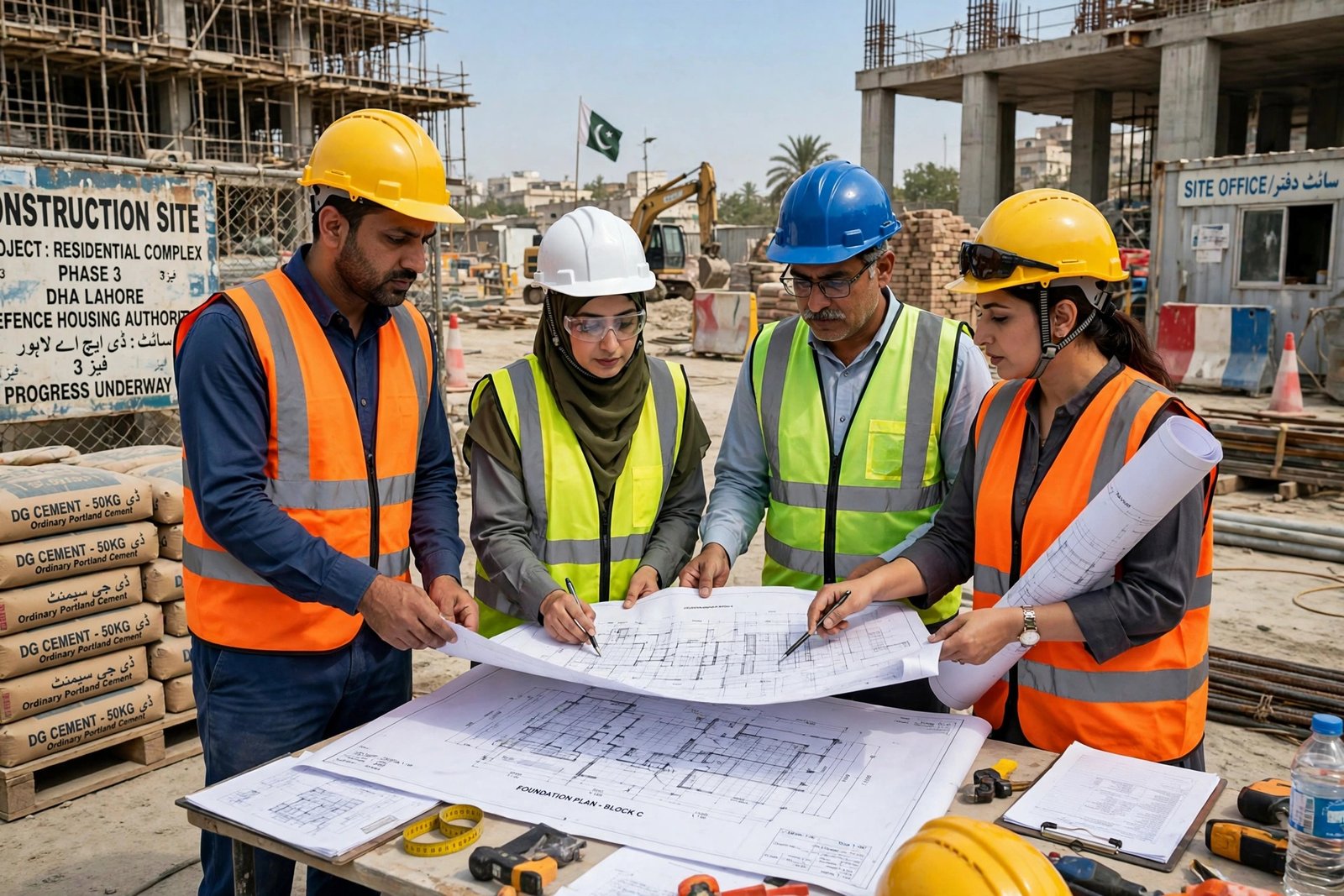
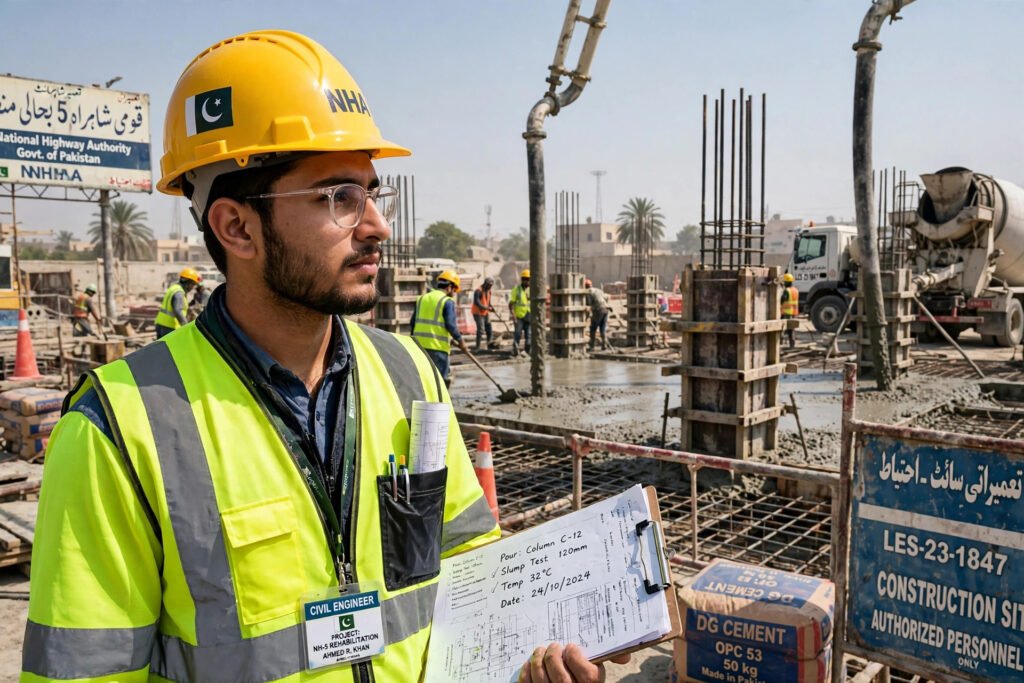
Civil engineering is a broad field, and the jobs split into a few clear types, starting with the site engineer — the most common first job for a fresh graduate. You are posted on a construction site — a housing project, a road, a bridge, a plaza — supervising labour, checking the quality of concrete and steel, reading drawings and reporting progress to the project manager. It is hands-on, long hours, and teaches you more in one year than four years of lectures.
A design engineer works in an office, usually at a consultancy, designing the structures site engineers build: structural drawings, load calculations and foundation design. A quantity surveyor, often called a QS engineer, handles the money side — bills of quantities, cost estimates, measuring work done and keeping the project within budget. It suits engineers who are good with numbers, and experienced quantity surveyors are in demand in Pakistan and in the Gulf.
A planning engineer works on schedules. Using tools like Primavera, you plan the sequence of construction, track progress and flag delays. Large contractors and consultants — the kind that build motorways, dams and housing schemes — always need planning engineers, and it is one of the better-paid specialisations once you have a few years of experience. Most engineers start on site and specialise later.
Education and PEC Registration: The Non-Negotiable Basics
The usual qualification for civil engineer jobs in Pakistan is a BE in Civil Engineering from a recognised university, or a DAE in Civil Technology from a technical board. A BE opens the widest range of jobs, including design and consultancy roles. A DAE is a solid route too, especially for site supervision, and many DAE holders build strong careers as site engineers, sometimes completing a BE later.
But the degree alone is not enough. Registration with the Pakistan Engineering Council, PEC, is essential — it is what makes you a recognised engineer in Pakistan. Government departments, large consultancies and reputable contractors ask for your PEC number before they look at your CV, and many advertisements state PEC registration as a requirement. If you have graduated and have not yet registered, do it now through the PEC website.
One honest point: your university’s name matters far less than most students think. A graduate who can produce a clean AutoCAD drawing and read a structural drawing will beat one from a famous university who cannot. Build the practical skills alongside the degree.
Where Civil Engineers Get Hired in Pakistan
The big public-sector employers are the names every civil engineer knows. NESPAK, the National Engineering Services Pakistan, is the country’s largest engineering consultancy, working on dams, roads, buildings and water projects across Pakistan and abroad. FWO, the Frontier Works Organization, builds roads, motorways and infrastructure in difficult terrain. NHA, the National Highway Authority, manages the national road network. WAPDA works on dams, hydropower and water projects, and its large projects employ engineers for years at a time. They advertise in newspapers and on their own websites, and many posts go through the public service commissions or testing services.
Then there are the development authorities and housing bodies: the CDA in Islamabad, the LDA in Lahore, other cities’ development authorities, and the big housing schemes — DHA and Bahria Town — which employ engineers for their own construction and infrastructure work. These jobs are popular for their government or semi-government benefits and stable postings in major cities.
The private sector is where most civil engineer jobs in Pakistan actually are. Private construction firms, from large contractors to small builders, hire site engineers for every project. Developers building housing societies, plazas and apartment blocks need engineers on site and in their offices. Consultancy firms hire design engineers and quantity surveyors, and firms in Lahore, Karachi, Islamabad and Rawalpindi are a good place for a fresh graduate to start, even at a modest salary, because the learning is fast.
Skills That Get You Hired
A civil engineering degree gets you into the interview. Your skills get you the job. AutoCAD is the first skill and the most important — almost every engineering office in Pakistan uses it, and an engineer who cannot work in AutoCAD is at a serious disadvantage. If you are still a student, learn it now: a few weeks of practice with free tutorials will take you from zero to employable.
Primavera P6 is the standard for project planning. STAAD Pro and ETABS are the structural analysis and design tools used by design engineers — if you want a design role, these get your CV shortlisted. Employers also value MS Excel for estimation and billing, and a working knowledge of surveying instruments like total stations is a real advantage for site roles.
If you are weighing engineering against the tech route, our guide to Software Engineer Jobs in Pakistan 2026 is a useful comparison — the two careers pay differently, hire differently and suit different kinds of people, and it is worth understanding both before you commit.
Beyond software, the skills that set engineers apart are practical: reading structural drawings fluently, preparing bills of quantities, knowing local material rates, and managing labour and subcontractors. None of this is taught properly in lectures — you learn it on site, from senior engineers, by asking questions.
Salary of Civil Engineers in Pakistan 2026
Let us be honest about pay, because unrealistic expectations cause more frustration than anything else. Fresh graduates usually earn PKR 40,000 to 70,000 a month in their first job, depending on the city, the employer and their skills. A graduate in Lahore or Karachi working for a private contractor will usually start at the lower end, while one with strong AutoCAD skills, PEC registration and an internship behind them can start higher.
Mid-career civil engineers, with roughly three to seven years of experience, usually earn PKR 80,000 to 200,000 a month. The range is wide because it depends on the role: a quantity surveyor or planning engineer earns more than a site engineer at the same level, and engineers on major projects earn more than those at small firms. Senior engineers with ten or more years of experience earn higher still.
Government jobs pay less at the start than the private sector, but they come with allowances, medical facilities, job security and a pension, which is why so many engineers keep trying for them. Do not refuse a decent first job because the salary is lower than you hoped. Your first two years are an investment — an engineer who spends two years on a real site, learning properly, will earn far more by year five than one who waited at home for a perfect offer.
Government Civil Engineer Jobs: FPSC, PPSC and KPPSC
Government civil engineer jobs in Pakistan are recruited through the public service commissions: the Federal Public Service Commission (FPSC) for federal posts, the Punjab Public Service Commission (PPSC) for Punjab, the Khyber Pakhtunkhwa Public Service Commission (KPPSC) for KP, and the equivalent commissions in Sindh and Balochistan. They advertise posts such as Sub Engineer, Assistant Engineer and Sub Divisional Officer in departments like irrigation, public health engineering and communication and works.
The process is familiar: the commission advertises in newspapers and on its website, you apply online, a written test is held, and shortlisted candidates are interviewed. The test usually covers your engineering subjects along with English, general knowledge and current affairs, and past papers are the most effective preparation. NTS also recruits for some departments, particularly for contract posts and bulk hiring at WAPDA and NESPAK.
Two warnings. First, government recruitment is slow — months from advertisement to selection is normal, so apply and keep working rather than waiting. Second, apply only through the official channel named in the advertisement; anyone who offers you a government engineering post in exchange for money is running a scam.
Civil Engineer Jobs Abroad: The Gulf Option
A large number of Pakistani civil engineers work in the Gulf, and for good reason. Saudi Arabia and the UAE are the two biggest destinations, with major construction, infrastructure and housing projects that need engineers constantly, and Saudi Arabia’s large-scale projects have increased demand further.
The usual route is through a licensed overseas employment promoter in Pakistan, or by applying directly to a construction company or consultancy in the Gulf. The Bureau of Emigration and Overseas Employment lists licensed promoters — only deal with one that is properly registered. The employer typically provides a work visa, accommodation or an allowance, transport and medical cover, and the salary is usually several times what a similar role pays in Pakistan.
What Gulf employers look for is experience. A fresh graduate will find it hard to get hired directly — the common path is to work two or three years in Pakistan, build a solid record on real projects, and then apply. Quantity surveyors, planning engineers and site engineers with high-rise or infrastructure experience are in particularly strong demand.
Be careful with agents. Never pay a large fee upfront to an unlicensed agent, and never hand over original documents to anyone you have not verified. A genuine offer comes with a proper contract, a visa processed through official channels, and a promoter you can check on the Protector of Emigrants’ records. If an offer promises a Gulf salary with no experience required and asks for money first, walk away.
Internships and First Jobs for Fresh Graduates
The hardest job to get in civil engineering is the first one, and internships are the best way through that wall. A two or three month internship at a consultancy, a contractor or a development authority gives you three things a degree cannot: real drawings to work on, a site to visit, and a reference from a working engineer. Many interns are offered a job by the same firm.
Apply for internships while you are still in your final year, not after graduation. Write to consultancies and contractors directly, visit their offices, and ask — many firms take interns informally. For your first job, widen the net and keep a record of every project you work on, because your CV in year three will be built from that record.
How to Apply for Civil Engineer Jobs in Pakistan
Finding civil engineer jobs in Pakistan in 2026 is straightforward. First, check the job boards. Most private-sector roles are advertised on job boards, and the largest list hundreds of engineering roles at any given time — you can browse current openings for civil engineer roles on Rozee to see what employers are asking for right now, including the salaries on offer and the skills listed in each advertisement.
Second, check the newspapers — Jang, Express, Dawn and Nawa-i-Waqt — for government advertisements, and the websites of FPSC, PPSC, KPPSC, NESPAK, FWO, NHA and WAPDA directly. Third, use LinkedIn: many firms post openings there, and a complete profile with your skills, PEC registration and project experience brings recruiters to you.
Fourth, apply directly: send your CV to a firm you want to work for or visit their office, even if they have not advertised — firms hire when a project starts, and a CV already on file gets called first. Finally, prepare a proper CV: one page for a fresh graduate, two at most for an experienced engineer. List your degree, PEC number, software skills, internships and projects, and check your phone number and email twice — many good CVs never get a call because of a wrong digit.
How to Spot Fake Engineering Job Ads
Engineering job seekers are targeted by fake advertisements just as much as any other group, and the pattern is depressingly consistent. A post on Facebook or WhatsApp promises a civil engineer job — in Pakistan, Saudi Arabia or Dubai — with a high salary and no experience required. Then comes the request for money: a registration fee, a visa processing fee, a security deposit, or a payment to an agent who claims to have influence with the hiring company.
No genuine employer charges you money to apply for a job. Application fees for government posts, where they exist, are paid only through the official channel named in the advertisement — a bank challan or the commission’s payment method — and the amount is always written in the advertisement itself. Private employers do not charge application fees at all. Anyone asking you to send money to a personal mobile account is running a scam.
Other warning signs: no company name or official source, an offer that arrives without you ever applying, a salary far above the market, a promise of selection without an interview or test, and pressure to pay immediately. Verify every advertisement against the employer’s official website or the newspaper it claims to come from, and for overseas jobs check that the promoter is licensed. Losing a few days to verification is far better than losing your money and documents to a stranger.
Final Word
Civil engineer jobs in Pakistan in 2026 are there for people who prepare properly and apply through the right channels. The construction sector is active, the Gulf remains open to experienced engineers, and government departments continue to recruit. The engineers who do well are not always the ones with the highest marks — they are the ones who registered with PEC, learned the tools, spent time on real sites, built a record of projects, and applied persistently.
Start now if you are serious. Get your PEC registration sorted, spend a few weeks getting good at AutoCAD, apply for internships while you are still studying, and keep applying — to consultancies, contractors, developers and government posts alike. Your first job may not pay what you hoped, but it is the foundation for everything after. In civil engineering, experience compounds, and the engineer you are in five years is decided by what you do in the first two.
FAQs
What qualification do I need for civil engineer jobs in Pakistan?
A BE in Civil Engineering from a recognised university, or a DAE in Civil Technology. Registration with the Pakistan Engineering Council (PEC) is essential — government departments, large consultancies and reputable contractors ask for your PEC number first.
What is the salary of a civil engineer in Pakistan in 2026?
Fresh graduates usually earn PKR 40,000 to 70,000 a month. Mid-career engineers with three to seven years of experience usually earn PKR 80,000 to 200,000 a month, and senior engineers earn higher. Pay varies by city, employer and role.
Which companies hire civil engineers in Pakistan?
NESPAK, FWO, NHA and WAPDA in the public sector, the CDA and LDA and housing schemes like DHA and Bahria Town, plus many private firms, developers and consultancies across Lahore, Karachi, Islamabad and Rawalpindi.
What skills should a civil engineer learn to get a job?
AutoCAD is the most important, followed by Primavera for planning, STAAD Pro and ETABS for design, and MS Excel for estimation and billing. Practical abilities — reading structural drawings, preparing bills of quantities and managing site work — matter just as much as software.
How can I get a civil engineer job in Saudi Arabia or the UAE?
Through a licensed overseas employment promoter, or by applying directly to a company or consultancy in the Gulf. Most Gulf employers want two to three years of experience in Pakistan first, and quantity surveyors, planning engineers and site engineers with high-rise or infrastructure experience are in the strongest demand.
How do I apply for government civil engineer jobs in Pakistan?
Government posts are advertised by the public service commissions — FPSC, PPSC, KPPSC and the Sindh and Balochistan commissions — and by NTS for some organisations. Apply only through the official channel named in the advertisement and never pay anyone who offers you a post in exchange for money.